The Storage Unit Problem
- Jeff Kluge
- 7 days ago
- 4 min read

by: Jeff Kluge, EVP Strategy & Corporate Development, Artist, and host of Talking Art
There are roughly 50,000 self-storage facilities in the United States. Combined, they hold more square footage than Manhattan. Americans spend upwards of $40 billion a year to keep things they cannot fit in their homes and will not throw away. This is not a logistics problem. It's an identity problem.
Ask anyone what's actually in the unit and you rarely get an inventory. You get a story. A dresser that belonged to a grandmother who crossed an ocean with nothing else. A box of drawings a father made before the kids were born. A painting — just a painting, canvas and paint and not much else to the eye — bought on a whim in a gallery in the 1970s, from an artist nobody had heard of yet.
We are not paying to store objects. We are paying to keep meaning alive a little longer, because we have no better mechanism for doing it.
The moment the meaning dies
Here is the quiet tragedy inside every estate sale, every unclaimed storage auction, every dumpster outside a house being cleared after a death: the object survives. The story doesn't.
Picture a painting — unremarkable to the untrained eye, a loose, expressive canvas that could pass for the work of a talented amateur. To the person who owned it, it was never really a painting. It was an evening. A studio visit decades ago, a conversation with the artist, a friendship that mattered more than the resulting canvas ever could. The painting was never the point. It was a vessel.
Now imagine that person is gone, and no one wrote any of it down. To the next generation, it's just paint on canvas. Worth framing, maybe. Worth keeping, maybe not. The meaning that took an evening to create and a lifetime to hold onto evaporates in a single act of inheritance, because meaning was never attached to the object in any durable way — only to the memory of the person who held it.
This happens constantly, at every price point, with every kind of object. It happens to museum-quality works whose provenance gets flattened into a wall label. It happens to family pieces that get sold at a fraction of their story's worth because the story was never transferable. The item survives. The identity does not.
We already know how to solve this — for money
Multigenerational families have spent centuries building infrastructure to keep financial capital intact across generations: trusts, governance structures, family offices, advisors whose entire job is continuity. The tools are sophisticated, well-tested, and taken seriously.
No equivalent infrastructure exists for cultural capital. There is no trust instrument for a story. No governance structure for "why this object mattered." Families that are extraordinarily disciplined about wealth transfer are, almost without exception, completely informal about meaning transfer — dependent on a conversation happening at the right dinner table, at the right time, before the person who holds the story is no longer able to tell it.
This is the gap.
Giving the object a voice
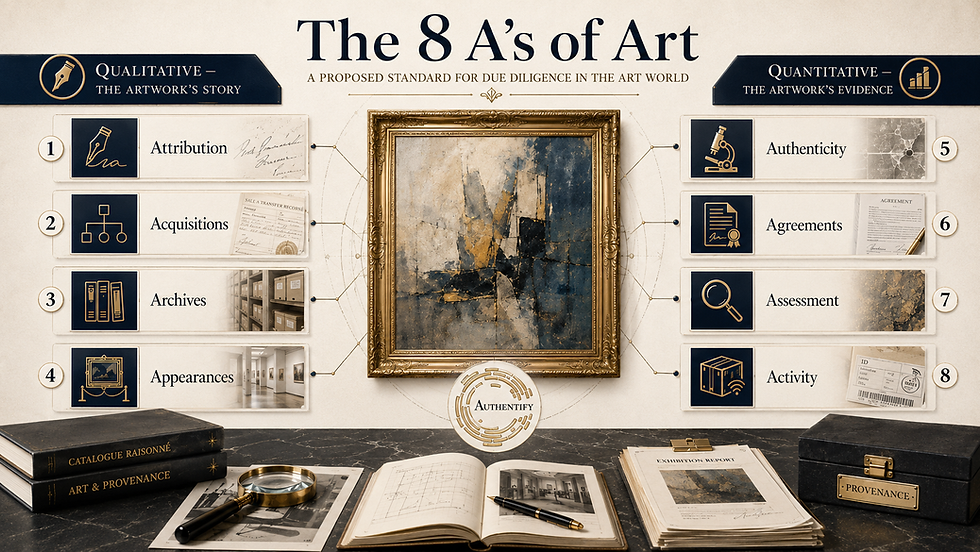
Authentify was built around a simple premise: the story shouldn't have to live in someone's memory to survive. It should live with the object itself.
Every item given a persistent identity through Authentify carries its own record — an Authentified Record built on Ground Fact, not just provenance paperwork but the layered history of an object: who made it, who held it, and why it mattered to the people who kept it. That record travels with the object permanently. It can be unlocked by proximity — someone standing in front of the piece — or by permission, so a family can choose exactly which parts of the story are for the next generation, which are for a future buyer, and which stay private.
The distinction matters: Authentify doesn't authenticate. It doesn't render a judgment on whether a work is genuine — that remains the province of experts, connoisseurs, and graders where relevant. What it does is something different and, for families, arguably more important: it gives the object a persistent identity, so that the meaning — not just the market value — has somewhere to live after the person who created that meaning is gone.
The data follows the art, not the other way around. Are you buying a painting — or this painting, the one from the studio visit, the one that matters because of what happened the evening it was made?
Every family has a storage unit
The families thinking hardest about this problem tend to be the ones already fluent in multigenerational stewardship — family offices, private trust companies, advisors who spend their careers thinking in terms of decades rather than quarters. They understand instinctively that a collection is never just a balance sheet line. It's compressed family history, and history that isn't actively preserved doesn't gently fade — it gets misfiled, sold at a fraction of its worth, or quietly discarded by someone who never got to hear the story.
The self-storage industry isn't evidence that Americans have a hoarding problem. It's evidence that we have an infrastructure problem — a mismatch between how much meaning we invest in objects and how little capability we have to make that meaning outlive us.
The technology to fix that finally exists. The only question left is whether families start using it before or after the story is already gone.