Does the Art World Need another Data Standard? Actually, yes!
The 8 A's of Art: An International Standard for Due Diligence in the Art World
Every specialist doing due diligence on an artwork already knows what "good" looks like — attribution that holds up, provenance that is traceable, condition reports that are current, paperwork that is comprehensive. Knowledge is not the problem. The problem is that no two specialists organize it the same way, and there is no standard language for describing how comprehensive the record keeping is, whether the records have been highly curated or even the actual quality of the scholarship or science.
The 8 A's is the first step to creating a standard digital dossier, making it much easier to root out fraud, measure quality, and scale the marketplace. This is not a new methodology. It is a shared structure to protect and manage the data that artists, experts, and value-added providers are already producing — data that already determines the value of every art asset.
We are not proposing the 8 A's in the abstract. Inside the Authentify platform, we are actively applying the 8 A's as a framework for our free due diligence tools — organizing real artwork data using this framework and its eight primary categories allows our users to track what documents exist and what is missing, and to score each file's completeness and strength in near real time. This post is an early look at the standard behind that tool, as it stands today and how it is being used in our collaboration with VasriK to power our insight engine — a tool to help researchers run deep investigations into provenance, scientific studies, and primary documents related to any artwork or artist.
The problem
Art is one of the largest unregulated asset classes in the world — an estimated $3T in privately held value according to Deloitte's Art & Finance Report — and still lacks a standardized way to document or evaluate the value or authenticity of any asset. Other markets and assets solved this problem as a basic precursor to growth — bonds have ratings agencies, trading cards have grading services, vehicles have title and history reports, diamonds have the GIA's 4Cs. Art continued to rely instead on relationships, reputation, and institutional memory — a tradition that works well for insiders, but a serious barrier to entry and a liability when it comes to market growth.
The result is a market that is harder to join, difficult to evaluate, and virtually impossible to price with confidence. Not because the underlying diligence work is necessarily missing or the work is not authentic, but because trust is only really possible when data is consistent, comparable, or understandable outside a small group of experts and insiders.
Why it matters
A common structure for due diligence is not just a convenience. It is the foundational standard that unlocks four things the art market is missing:
Transparency. A standardized structure makes it clear what is known about an artwork, what is missing, and where the supporting documents and evidence come from. Furthermore, with an auditable history, value can be protected and built on.
Liquidity. Illiquid assets like art move more easily when buyers can evaluate them quickly and with confidence. Standardized due diligence and secure digital access to a structured due diligence deal room (common for companies and real estate) greatly simplify this and shorten the evaluation cycle.
Participation. Currently, meaningful participation in the art market is gated by insider knowledge even more than by capital. A common framework lowers that barrier — it gives outsiders a real, credible way to understand and evaluate the artwork in front of them, and to participate with greater confidence that they are not being cheated or taken advantage of.
Consistent scoring and risk analytics. When every artwork's diligence is organized the same way, it becomes possible to score and compare data across the market on the same basis. This is the first step to effectively scaling risk management for insurance, banking, and investment purposes.
The result: a larger art market — one where more capital and more participants can engage with confidence, while doing a better job of valuing expertise and protecting all participants from fraud.
The taxonomy
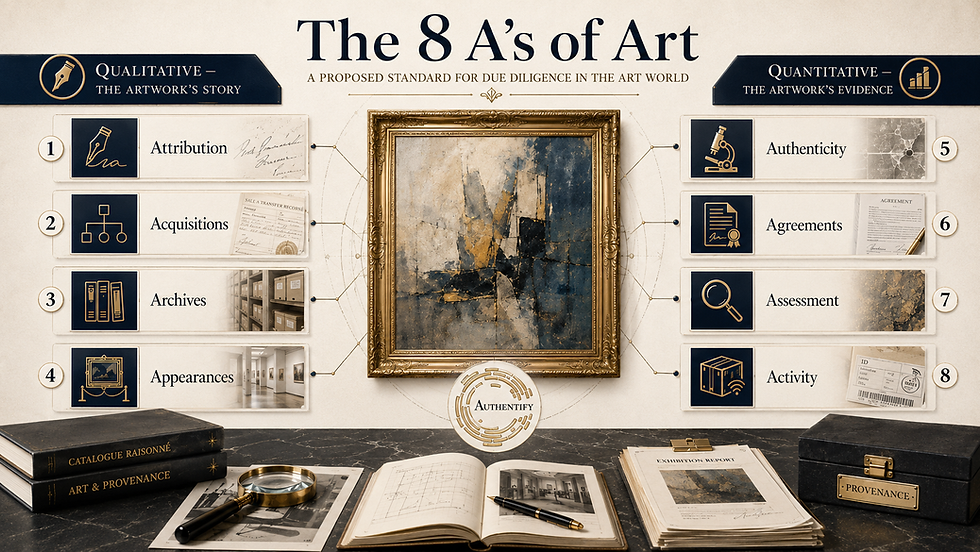
The 8 A's of Art is a framework designed to reflect the value chain of the art ecosystem. For the purposes of a collection management application, it organizes all due diligence — primary documents, opinions, assessments, and any other evidence — into a shared taxonomy of eight primary categories, divided into two groups, qualitative and quantitative. The reason for using the A's is largely driven by marketing and an homage to the 4Cs of diamonds and gems. Below are the categories and in the parentheses are the other terms that are commonly used to characterize the data.
Qualitative — the artwork's story:
Attribution (Authorship & Connoisseurship) — Expert Opinions, Academic Papers, Artist's Signature and Marks, Appraisal, Labels on Artwork, Attribution Correspondence
Acquisitions (Provenance & Sales) — Provenance / Ownership History, Sales History, Foundations / Estate, Digital Provenance Records (Blockchain), Labels / Inscriptions / Identifiers, Acquisitions Correspondence
Archives (Bibliography & Literature) — Catalogue Raisonné, Book, Article, Catalog Entries, Critiques and Reviews, Primary Evidence, Rare Books, Diary/Notebook, Archives Correspondence, Auction Catalog
Appearances (Exhibitions & Showings) — Museum, Traveling Show, Auction, Gallery, Public Installation, Appearances Correspondence
Quantitative — the artwork's evidence:
Authenticity (Validation & Scientific Analysis) — Authentication Report, Chemical Analysis / Materials Report, Imaging, Microscopy, Pigment Analysis, Spectroscopy, Other Scientific Evidence, Authenticity Correspondence
Agreements (Legal & Financial) — Art Loss/FBI, Certificate of Authenticity, Bills of Sale, Authentified, Lien, Encumbrance, Contract, Copyright, Insurance Policies, Valuation Reports / Estimates, Insurance Valuations, Right of First Refusal, Royalties, Loan, Will, Tax Documentation, Other Financial Documents, Agreements Correspondence
Assessment (Health & Condition) — Condition Report, Condition Photography, Conservation Treatment Records, Restoration Analysis, Environmental Readings, Environmental Monitoring Data, Dimensions, Alerts, Assessment Correspondence
Activity (Logistics & Storage) — Shipping Records, Storage Receipts, Customs Records, Bills of Lading, Proof of Life, ID Tags, Tag Installations, Tag Interactions, Crate Dimensions, Activity Correspondence
By adopting this taxonomy, the eight categories do more than organize a file — they make it accountable. Every claim is anchored to a document, and every document is traced back to its source. That is what makes a dossier faster to build, easier to defend, and possible to compare against any other file in the market, because two specialists working from the same structure are finally speaking the same language. The larger payoff is not immediate — it compounds over time: a standard rigorous enough for scholarship is rigorous enough for court. Court cases run on evidence. A standardized way of assembling it is what lets a judge, an insurer, or a buyer verify that evidence directly, rather than simply trust it.
Where this stands
This open standard is in its beta stage — inspired by the model the GIA built for diamonds, and adapted for a market with a much wider range of specialists and institutions. We have prototyped it, and we expect it to evolve as more experts use it. In order to get input from the specialists, conservators, and institutions, we have made the Authentify platform free. Our technical team iterates weekly and easily accommodates adding missing categories, document types, and metadata needs. We believe this is just the first step in helping the industry grow and expect many of the early adopters to become part of the governance that will maintain and direct the standard going forward.


