Day Zero: The $11 Million Card and the Memory of Modern Assets
- Jeff Kluge
- 6 days ago
- 4 min read
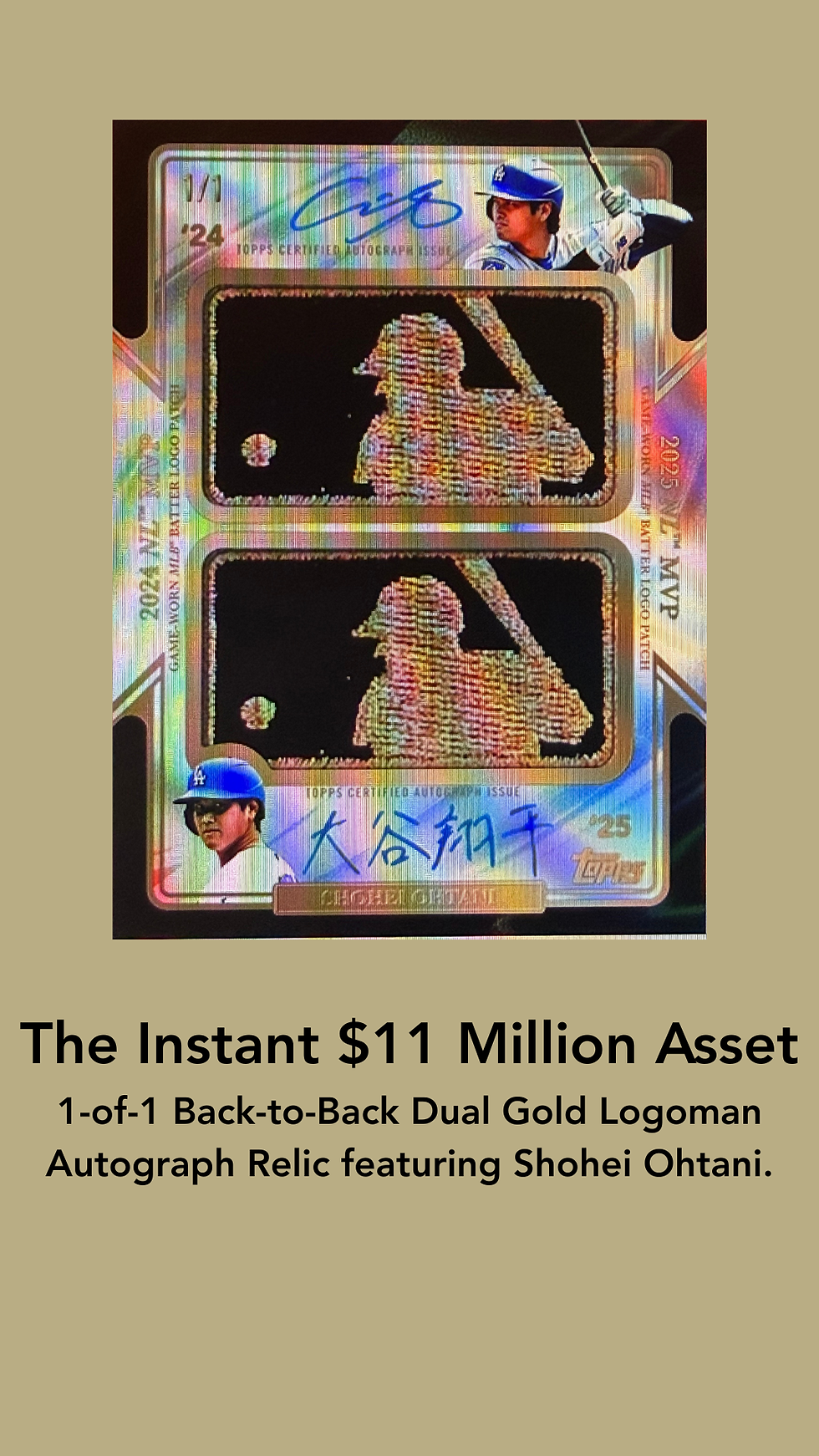
The Instant $11 Million Trading Card
On a summer evening in Boca Raton, Florida, a longtime customer of Boca Sports Cards opened a hobby box of 2026 Topps Chrome Baseball at home. Sliding out from the foil pack was a redemption card for a piece of memorabilia created only months earlier: the 1-of-1 Back-to-Back Dual Gold Logoman Autograph Relic featuring Shohei Ohtani.
Within hours, what started as a pull at home became an international frenzy. A multi-million dollar bounty for the card had already circulated on social media, and the collector reached out directly to the interested party. By that Friday, the card had sold for a record-breaking $11 million to the @SecureCollectibles portfolio—a high-profile collective including entrepreneur Kevin O'Leary, Matthew "Shyne" Allen, and Paul Warshaw.
The price traces directly to what's physically embedded in the card. Commemorating Ohtani's back-to-back National League MVP campaigns, it holds two gold MLB logo patches cut from game-worn jerseys: one from a two-homer road game against the Orioles on September 7, 2025, the other from a leadoff home run at Dodger Stadium on April 12, 2026. Ohtani signed the card twice on-card—once in English script, once in native Japanese Kanji.
Overnight, a single redemption slip became the third highest-priced sports trading card in history, trailing only the 2007–08 Upper Deck Exquisite Collection Dual Logoman Autograph of Michael Jordan and Kobe Bryant at $12.932 million, and the 1952 Topps Mickey Mantle at $12.6 million.
That first card is worth pausing on. The Secure portfolio also purchased the Jordan/Bryant Logoman, at auction in 2025. Which means a single collective now holds the number one and number three sports card sales in recorded history.
That concentration matters more than it first appears. When the most valuable physical objects in a category consolidate into fewer hands, the records that establish what those objects are become correspondingly more consequential—and correspondingly more dependent on whoever happens to be holding them.
The Fragmented Record
The Ohtani Logoman is a masterclass in modern physical asset creation, but it immediately raises a critical question: where does the Ground Fact of this $11 million card actually live today?
The answer is that it lives everywhere and nowhere at once. The evidence that proves what this card is—and why it's worth millions—is fractured across dozens of disconnected corporate and public silos:
The Uniform Authentication: proof that the Gold Logoman patches were worn during specific home runs lives inside Major League Baseball's internal authentication database.
The Creation & Signing Logs: confirmation of the on-card dual signatures and redemption issuance sits in private corporate files at Topps and Fanatics.
The Discovery & Chain of Custody: the bounty, the pull, and the story of how it happened live on ephemeral social posts and a single interview with the shop owner.
The Valuation & Sale: the record of the $11 million transaction lives in news snippets from sports outlets and private auction receipts.
Here lies the modern paradox: we possess more digital data than at any point in history, yet it remains wildly fragmented and completely detached from the physical asset itself. If a corporate database is restructured, if links break, or if private files disappear in a corporate acquisition twenty years from now, the card sits in a vault, separated from the digital paper trail that proves its own origin.
The Parallel to Olbermann
This dynamic connects directly to the story of Keith Olbermann's 1909 T206 Honus Wagner.
Olbermann's card sat hidden in a drawer for 27 years because a single restorer disconnected his phone and vanished, taking the record of its physical restoration with him. That was a vintage problem—born of analog secrecy, private notebooks, and lost phone numbers.
It's tempting to assume a modern card like the $11 million Ohtani is immune. It was born in the full glare of global publicity, covered by national news outlets, backed by major corporate entities. But it carries the exact same structural vulnerability.
Fifty years from now, when this card passes to a new generation of collectors or institutional custodians, no one will be relying on a working web link to a 2026 news article or an archived social post. If those third-party records go dark, future appraisers will be forced to re-examine the game-worn patches and signatures from scratch—using forensic imaging to prove what should have been self-evident all along.
The lesson from the vintage market applies directly to modern assets: trust that depends on third-party servers, corporate goodwill, or temporary internet links isn't infrastructure. It's luck with a clock on it.
Ground Fact at the Origin: Authentify &
This dynamic shows the obvious connection that goes beyond fine art. It is precisely why we are expanding Authentify Art to Authentify &—a horizontal identity protocol for every category of high-value physical asset—and Collectibles is where we're beginning.
Modern provenance cannot be retrofitted decades later through guesswork or forensic recovery; it has to be captured at Day Zero—the exact moment a high-value physical asset is created, discovered, or issued.
Rather than a static certificate or a scattered trail of press releases, Authentify binds serial-level Ground Facts directly to the physical object at the moment of creation, through a permanent, portable Authentified Record. Every critical piece of data is anchored to the card's unique identity:
The MLB uniform authentication serial numbers confirming game-worn patch origin.
The manufacturer's signing session logs verifying the dual-language autographs.
The timestamped record of the pull, and every verified transaction after it.
The goal of Authentify & Collectibles is not to replace card manufacturers, grading companies like CGC or PSA, or league authentication programs. The goal is to provide the horizontal infrastructure that binds their combined expertise directly to the physical serial number—so history travels with the object across every future owner, auction house, and decade.
Authentication answers a question once. Identity creates a record that answers it forever. By establishing Ground Fact at Day Zero, we make sure an $11 million modern masterpiece never has to spend 27 years in a drawer waiting to prove what it already was.

